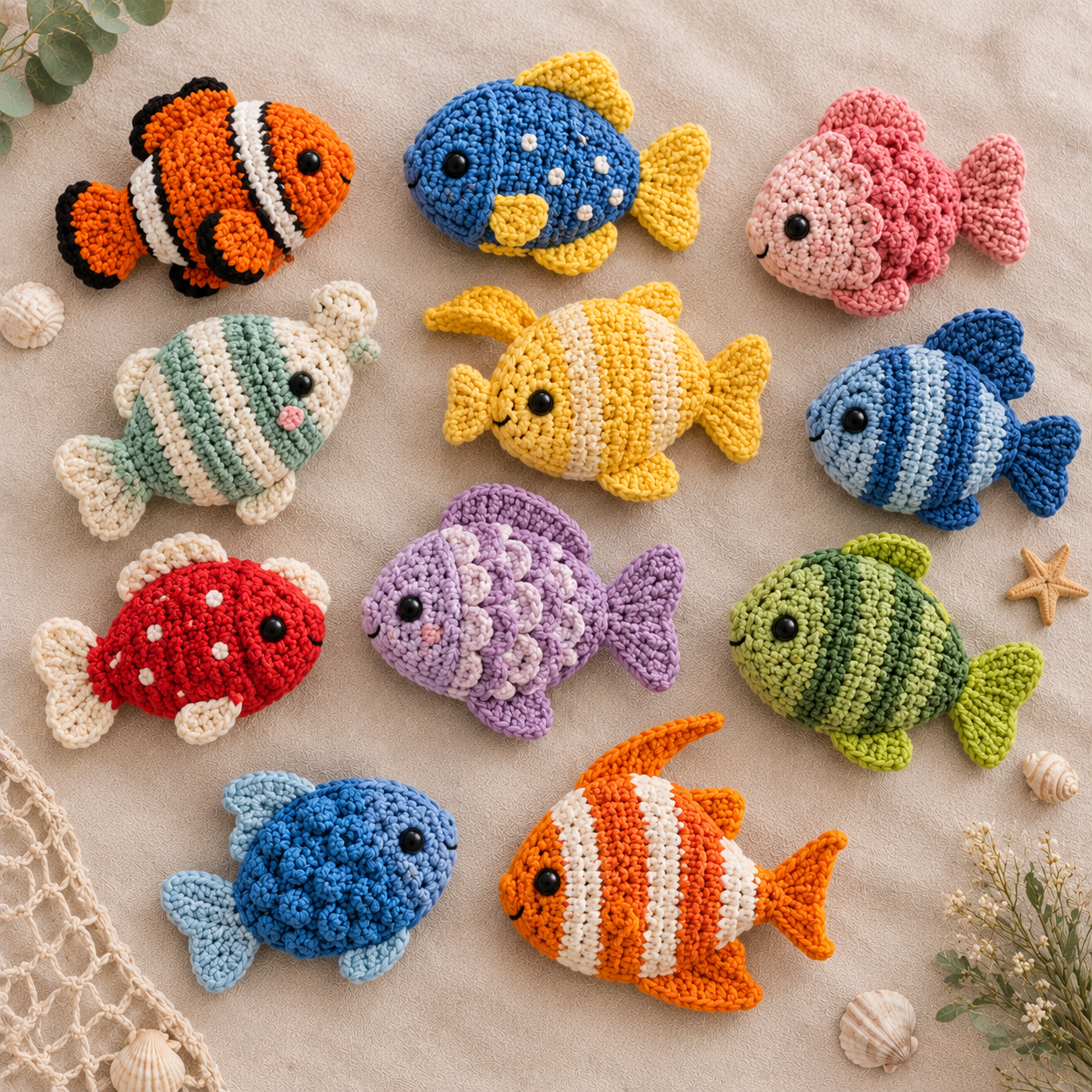
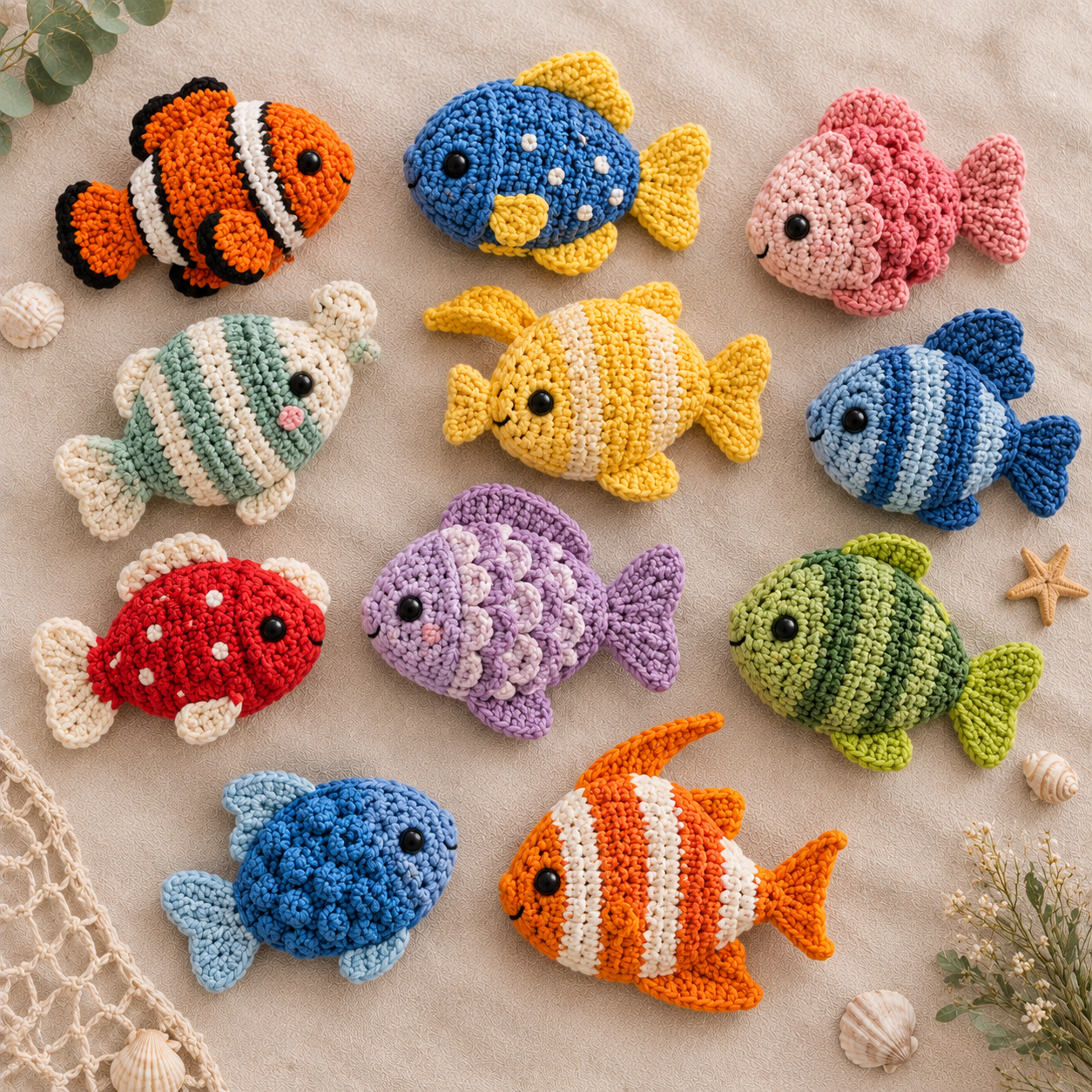
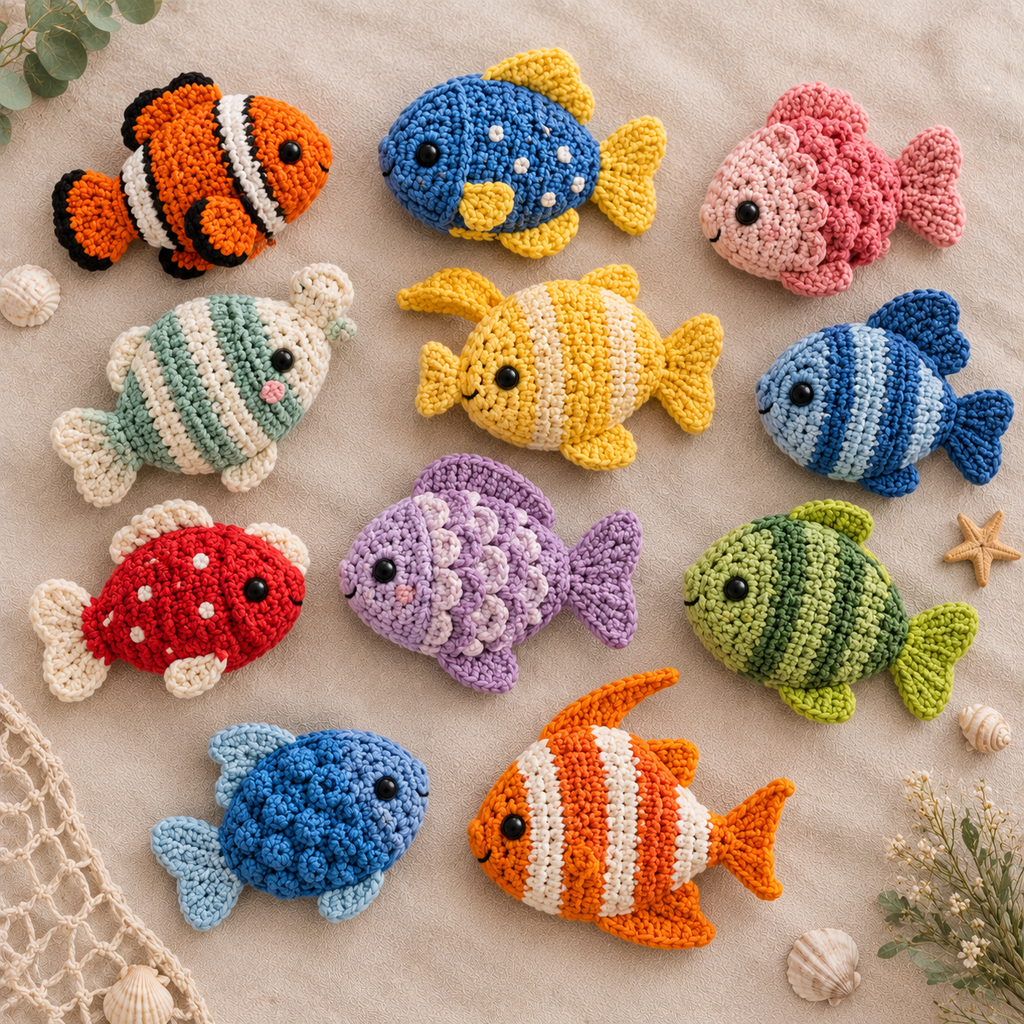
Fish give you a lot of room to play with color and fine shape without needing much in the way of complicated limbs or facial features. Here are 8 crochet fish ideas that will steal your heart, along with a look at the two basic body shapes most fish amigurumi are built from.
Flat Disc vs. Elongated Tube
Most crochet fish start from one of two basic shapes. A flat disc body, worked in the round and finished as two matching sides seamed together, gives a wide, laterally compressed shape that suits fish like angelfish or pufferfish, whose real bodies are noticeably taller than they are thick. An elongated tube body, worked more like a standard amigurumi animal with gradual shaping along its length, suits a longer, more streamlined fish like a koi. Neither shape is more difficult than the other; the right choice just depends on which real fish, or imaginary one, you’re trying to capture.
8 Crochet Fish Ideas to Try
1. The Clownfish
Bold orange and white stripes edged in a thin black outline recreate one of the most recognizable fish patterns there is. The stripes are worked as simple color changes around a flat disc body, making this one of the most approachable designs on this list despite its high-contrast look.
2. The Betta Fish
Long, flowing fins worked in a soft, slightly ruffled stitch and trailing well past the body capturing a betta’s dramatic, showy silhouette. The fins take more time than the compact body itself, since getting them to drape naturally rather than stick out stiffly takes a bit of practice.
3. The Angelfish
A tall, narrow, almost diamond-shaped body paired with long, elegant fins along the top and bottom gives this design a distinctly different proportion from most other fish on this list. The flat disc construction method works especially well here, since angelfish are naturally very thin from side to side.
4. The Koi Fish
An elongated tube body worked in mottled patches of white, orange, and black mimics the irregular markings seen on real koi. Placing the color patches unevenly, rather than in a repeating pattern, gives a more convincing, natural-looking result than a symmetrical design would.
5. The Pufferfish
A round, inflated-looking body covered in small evenly spaced bobble stitches recreates a pufferfish’s spiky, alarmed appearance in a soft, huggable form. The bobbles are the main technical feature here, and spacing them evenly across a curved surface takes a bit more planning than a smooth, plain body.
6. The Seahorse
Technically a fish despite its unusual shape, a seahorse is built from a curled, S-shaped body with a long snout and a coiled tail rather than the typical fish silhouette. The curled tail is the trickiest part to get looking natural, since it needs to hold its spiral shape once stuffed.
7. The Sparkly Scale Fish
A body worked mostly in one bold color but with a scattering of metallic or iridescent scales mixed in across the sides gives this fish a shimmering, storybook quality. The sparkly scales are usually small individual pieces or French knots added after the main body is finished, so they don’t complicate the base shape.
8. The Hanging Fish Mobile Set
A handful of small, simplified fish shapes in coordinating colors, each finished with a loop at the top, hang together from a ring or dowel to make a gentle, moving mobile for a nursery or reading nook. Keeping each fish lightweight and minimally stuffed matters here, so the whole set moves easily in a light breeze rather than hanging stiff and motionless.
Tips for Getting Fins Right
Work fins as separate flat pieces rather than shaping them directly into the body, since a flat fin is easier to position at exactly the angle you want and easier to redo if it doesn’t look right the first time. For a flowing style like the betta, a slightly looser tension than you’d normally use helps the fin drape rather than stand stiffly away from the body.
Common Questions
Which Fish Pattern Is Easiest for a Beginner?
The clownfish is a good starting point, since it relates to a straightforward flat disc body with simple color changes rather than any elaborate fins or texture. Save the betta and the seahorse, both of which ask for more shaping finesse, for once you’re comfortable with the basics.
Should I Use the Flat Disc Method or the Tube Method for My Fish?
It depends on the fish you’re making. A naturally thin, tall-bodied fish like an angelfish or pufferfish suits the flat disc method, while a longer, more cylindrical fish like a koi generally looks more accurate working as an elongated tube.
How Long Does It Take to Crochet a Fish?
Most standard-sized fish take somewhere between 1 and 3 hours, with more detailed designs like the betta or the sparkly scale fish generally taking a bit longer because of their added fins or embellishments. A single fish for the mobile set finishes fastest, since it’s kept intentionally simple and lightweight.
What Yarn Works Best for a Crochet Fish?
A smooth, tightly spun cotton or cotton-blend yarn gives clean stitch definition for color changes like the clownfish’s stripes or the koi’s patches. A softer acrylic works well for a fish meant to be handled and cuddled regularly, like a nursery mobile piece.
How Much Yarn Does a Fish Amigurumi Use?
Most standard-sized fish use somewhere between 60 and 150 yards of worsted-weight yarn, with a design that includes long, flowing fins, like the betta, generally using more because of the extra fine pieces.
Can I Turn a Flat Disc Fish Into a Fully Rounded One?
Yes, to an extent. Adding a few extra rounds of increases in the middle rather than shaping straight toward a flat seam gives the body more volume, though it will move the finished fish further from the naturally thin, laterally compressed shape that the flat disc method is meant to recreate.
Are These Fish Safe for a Baby’s Nursery Mobile?
With a few adjustments, yes. Skip small plastic safety eyes and beads in favor of embroidered features, keep each fish lightly stuffed so the finished mobile stays soft and light, and make sure the mobile itself is hung well out of reach of a crib rather than within grabbing distance.
Final Thoughts
Fish offers a rare mix of simple construction and huge visual variety, since a change in color, fin shape, or body proportion can take the same basic technique in a completely different direction. Pick whichever species or style catches your eye, and you’ll have a genuinely charming little fish ready before long.